
How to reduce packaging waste with fulfillment center strategies

Packaging waste has become one of the most pressing operational and environmental challenges facing eCommerce businesses today. As online shopping volumes continue to grow, so does the volume of cardboard boxes, plastic fillers, and single-use materials flowing through fulfillment centers Mexico and worldwide. For logistics managers, sustainability directors, and eCommerce operators, developing a structured approach to waste reduction is no longer optional; it is a competitive and regulatory imperative.
This article will help you understand fulfillment center strategies to reduce packaging waste, how to improve material efficiency, and build a more sustainable supply chain from the inside out. If you’re interested in establishing an eco-friendly foundation for your business, this content is for you.
Why packaging waste has become a major challenge for eCommerce businesses
The eCommerce industry generates an estimated 180 million metric tons of packaging waste annually, a figure that has accelerated significantly since the surge in online retail following 2020. Unlike traditional retail, where products are displayed and transported in bulk, eCommerce relies on individual shipments — each requiring its own protective packaging, void fill, and outer carton.
This individualized approach creates several compounding problems:
-
Excessive material use: Many shipments use boxes 40–60% larger than necessary, resulting in significant cardboard and filler waste.
-
Customer dissatisfaction: Studies consistently show that consumers view excessive packaging negatively, associating it with environmental irresponsibility.
-
Rising costs: Material, labor, and disposal costs tied to packaging can represent 10–15% of total fulfillment expenses.
-
Regulatory pressure: The European Union's Packaging and Packaging Waste Regulation (PPWR) and similar frameworks in North America are pushing brands toward mandatory recyclability and waste reduction targets.
For fulfillment centers processing thousands or millions of orders per year, even marginal improvements in packaging efficiency translate into substantial cost savings and measurable environmental benefits.
Where packaging waste typically occurs in fulfillment operations
Before implementing sustainability initiatives, it is essential to understand exactly where waste is being generated. Most packaging waste in fulfillment operations can be attributed to five primary sources.
1.- Oversized shipping boxes
Choosing the wrong box size is the single largest driver of packaging waste in eCommerce fulfillment. When warehouse teams rely on a limited range of box sizes, small items frequently ship in oversized cartons. This wastes cardboard, increases the volume of void fill materials required, and raises dimensional weight shipping costs. A fulfillment operation shipping 10,000 orders per day with an average 30% box oversizing can waste millions of square feet of corrugated material annually.
2.- Excessive void fill materials
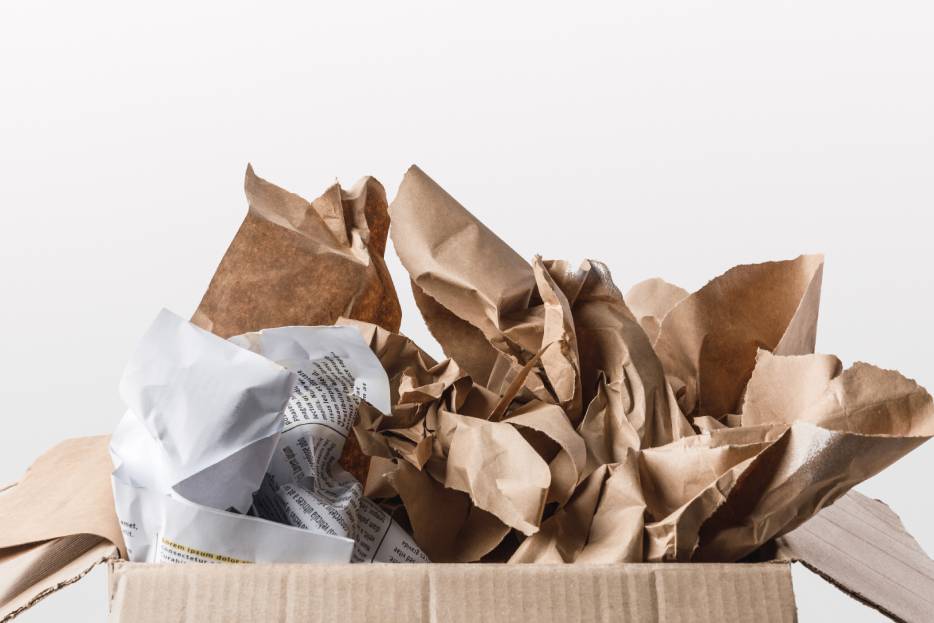
Void fill —including air pillows, foam peanuts, crumpled paper, and bubble wrap— is used to prevent products from shifting inside boxes. However, many packing stations use fill materials reactively and inconsistently, applying far more than is needed. This not only increases material costs but also results in bulky, difficult-to-recycle waste that ends up in landfills.
3.- Single-use packaging components
Plastic poly bags, non-recyclable foam inserts, composite laminate mailers, and mixed-material pouches are efficient from a protection standpoint but represent a significant sustainability liability. Most of these materials cannot be recycled through standard curbside programs, meaning they are almost always disposed of in landfills or incineration streams.
4.- Inefficient packaging processes
Without standardized packing guidelines, individual packers make their own judgment calls on box selection, fill quantity, and seal method. This inconsistency leads to both over-packing and under-packing, increasing both waste and damage rates. Inefficient workflows also slow throughput, which can pressure packers to use the nearest available box regardless of fit.
5.- Product damage and repackaging
When products are damaged in transit due to inadequate protective packaging, the result is doubly wasteful: the original packaging is discarded, and new packaging materials must be used for replacement shipments. Return shipments generate their own additional packaging waste, creating a feedback loop that multiplies environmental impact.
Fulfillment center strategies to reduce packaging waste
There are several strategies businesses can implement to reduce packaging waste and improve the efficiency of their fulfillment operations. By adopting the following measures, companies can minimize their environmental impact while optimizing their resources.
Conduct a packaging audit before implementing sustainability initiatives
The most effective sustainable packaging programs begin not with new materials, but with data. A packaging audit is a systematic review of all materials currently used in fulfillment operations, the volume consumed, the cost per unit, the damage rate associated with each pack type, and the downstream recyclability of each material.
A thorough audit typically covers:
-
Material inventory: Catalog every box size, mailer type, void fill material, tape, and label used across all SKUs.
-
Usage data: Track how many units of each material are consumed per week or month.
-
Fit analysis: Measure the average ratio of product volume to shipping carton volume across order types.
-
Damage correlation: Cross-reference packaging types with return and damage rates.
-
Disposal pathway review: Identify what percentage of current materials are recyclable, compostable, or landfill-bound.
This baseline data allows teams to prioritize interventions by impact, targeting the highest-waste and highest-cost packaging decisions first. It also creates a benchmark for measuring progress after sustainability initiatives are implemented.
Optimize packaging design to reduce material consumption
Once audit data is available, the next step is redesigning packaging structures to use fewer materials without compromising product protection.
Simplifying packaging structures
Many products ship with multiple layers of packaging that have accumulated over time without deliberate design review — a primary product box, inside a padded mailer, inside a shipping carton. Simplifying these structures by eliminating unnecessary layers reduces material input, labor time, and package weight.
Designing for product protection and efficiency
Right-sized packaging — where the shipping container closely matches the dimensions of the product — reduces the need for void fill and minimizes the risk of in-transit damage. Many fulfillment operations are now adopting on-demand box-making systems that custom-cut corrugated cartons to the exact dimensions of each order, reducing both overage material and filler requirements by up to 50%.
Replace traditional materials with sustainable alternatives
Material substitution is one of the fastest ways to reduce the environmental footprint of packaging without requiring major process changes. The following categories represent the most widely adopted and commercially available sustainable alternatives.
|
Material Type |
Traditional Alternative |
Sustainability Benefit |
Common Applications |
|
Recyclable corrugated |
Mixed-material cartons |
Widely accepted in curbside recycling |
Outer shipping boxes |
|
Compostable mailers |
Plastic poly mailers |
Biodegrades in industrial composting |
Soft goods, apparel |
|
Recycled content packaging |
Virgin fiber boxes |
Reduces demand for new raw materials |
All carton types |
|
Paper-based void fill |
Foam peanuts, air pillows |
Curbside recyclable, biodegradable |
Fragile item packing |
|
Mushroom packaging |
Expanded polystyrene |
Compostable, moldable |
Electronics, fragile items |
Reduce product damage to prevent additional packaging waste
Product damage is often overlooked as a packaging waste issue, yet every damaged item that requires reshipment doubles the packaging and transportation resources consumed for that order. To prevent additional waste caused by these situations, some key strategies include:
-
Better product handling: Implementing standardized product handling protocols throughout receiving, picking, and packing processes reduces the rate of warehouse-caused damage.
-
Quality control processes: Adding quality control checkpoints before packages are sealed reduces both damage-related returns and repackaging events. Even a simple checklist at the packing station can reduce error rates by 20–30%.
-
Protective packaging optimization: The goal is not to eliminate protective packaging, but to use the minimum effective quantity. Using data from damage audits can be helpful to identify where more protection is genuinely needed and where current fill levels are excessive.

Train fulfilment teams on sustainable packaging
Technology and material choices alone cannot achieve packaging waste reduction. The people packing orders every day have the greatest direct impact on actual material consumption, and their behavior is shaped by the training and guidelines they receive.
-
Packaging guidelines: Develop clear, visual packaging guides for each product category. These guides at packing stations ensure consistency regardless of shift or experience level.
-
Waste reduction procedures: Establish procedures for handling packaging materials. Small procedural changes, when consistently followed, produce significant aggregate reductions.
-
Employee accountability programs: Recognition programs that reward teams for meeting or exceeding sustainability targets reinforce a culture of waste reduction.
Collaborate with suppliers to minimize packaging waste
A fulfillment center's packaging footprint extends upstream to the vendors and manufacturers who pack and ship inbound inventory. Supplier collaboration is a high-leverage opportunity that is often underutilized.
-
Supplier packaging standards: Establish formal packaging standards for inbound shipments and communicate them clearly to all suppliers.
-
Bulk packaging programs: Encouraging suppliers to ship in bulk reduces the volume of inner packaging that must be discarded upon receiving.
FAQS about sustainable packaging and fulfillment
Does reducing packaging waste improve brand perception?
Yes, consistently and significantly. Consumer research shows that more than 60% of consumers consider a brand's environmental commitment when making purchase decisions, and packaging is one of the most visible signals of that commitment. Brands that visibly reduce packaging waste — particularly by eliminating plastic and right-sizing boxes — report measurable improvements in customer satisfaction scores and repeat purchase rates.
What industries generate the most packaging waste in eCommerce?
The highest packaging waste volumes in eCommerce are generated by:
-
Consumer electronics
-
Health and beauty
-
Apparel and footwear
-
Grocery and food delivery
These categories are also among the most active in adopting sustainable alternatives, given regulatory scrutiny and consumer visibility.
Can small fulfillment operations implement waste reduction strategies?
Yes. Reducing packaging waste is not limited to large fulfillment centers with extensive resources. Small fulfillment center operations can also implement effective waste reduction strategies, often with relatively low investment and immediate operational benefits.
What certifications support sustainable fulfillment practices?
Several certifications help validate and communicate sustainable packaging practices to customers and partners:
-
FSC (Forest Stewardship Council): Certifies that paper and wood fiber packaging comes from responsibly managed forests.
-
SFI (Sustainable Forestry Initiative): A North American equivalent to FSC for forest-sourced materials.
-
How2Recycle: A standardized US labeling program that communicates the recyclability of packaging components to consumers.
-
Cradle to Cradle: A product certification that evaluates material health, recyclability, renewable energy use, water stewardship, and social fairness.
-
BPI (Biodegradable Products Institute): Certifies compostability for packaging materials destined for industrial composting streams.
How can businesses communicate packaging sustainability efforts to customers?
Transparency and specificity are the keys to credible packaging sustainability communication. Rather than vague claims ("eco-friendly packaging"), effective communication provides concrete metrics:
-
Percentage of recycled content
-
Reduction in plastic use
-
Packaging recyclability rate
-
Carbon saved per shipment
In-package messaging, post-purchase email flows, and dedicated sustainability pages on the brand website are all effective channels. QR codes printed on packaging that link to a sustainability report or material breakdown are increasingly common and well-received by environmentally engaged customers.